
 English
The AI infrastructure boom has exposed a fundamental mismatch: GPU architectures now iterate on an annual cadence, yet traditional data center construction still follows a multi-year, stick-built playbook. Containerized and prefabricated modular data centers are emerging as the industry's structural response to this gap — delivering compute capacity in months rather than years, and in some cases, within days.
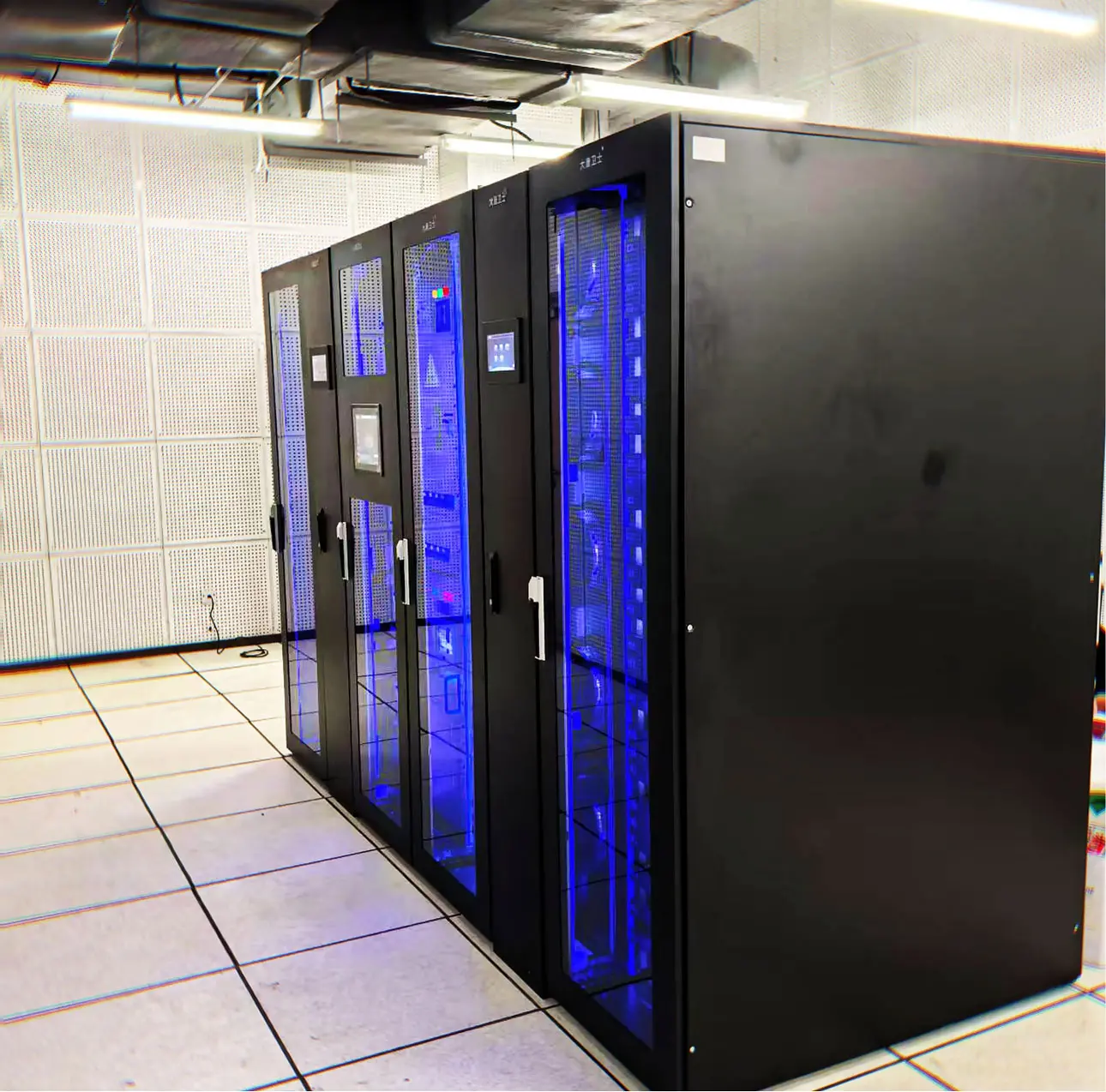
The Deployment Gap
Traditional data center builds require 24 to 36 months from planning to commissioning, a timeline that means by the time a facility is ready, the GPU generation it was designed to house is already obsolete. The problem is compounded by power density. Forced-air cooling hits a practical wall at approximately 25kW per rack, yet NVIDIA H100 clusters routinely exceed 40kW, and the B200 pushes past 100kW. Conventional designs simply cannot keep pace.
The financial implications are equally stark. Conventional construction demands massive upfront capital — land acquisition, permits, civil works, MEP infrastructure — all before a single server is racked. For AI projects where time-to-compute directly translates to competitive advantage, this model has become untenable.
Market Momentum
The numbers reflect the urgency. The global modular data center market was valued at approximately $41.35 billion in 2025 and is projected to reach $101.22 billion by 2031, growing at a CAGR of 18.87%. Within this, the prefabricated data center segment accounted for 44.37% of market share in 2025, with Asia Pacific positioned as the fastest-growing region at a CAGR of 18.65%. Edge deployment dominated the deployment model segment with a 39.74% revenue share in 2025, driven by demand for low-latency compute in unserved and underserved metros.
The containerized data center sub-segment is expected to reach $41 billion by 2031, according to industry projections. This growth is not speculative — it is being driven by hyperscale operators increasingly favoring modular deployment models to accelerate capacity rollout and improve capital efficiency.
What Containerized Solutions Deliver
A containerized AI data center is a fully integrated, factory-tested computing facility encapsulated within a standard ISO shipping container. It arrives on-site with servers, GPUs, power distribution, cooling systems, security, and remote monitoring pre-installed and validated. Factory prefabrication rates exceed 90%, with on-site commissioning requiring only power, water, and network connections.
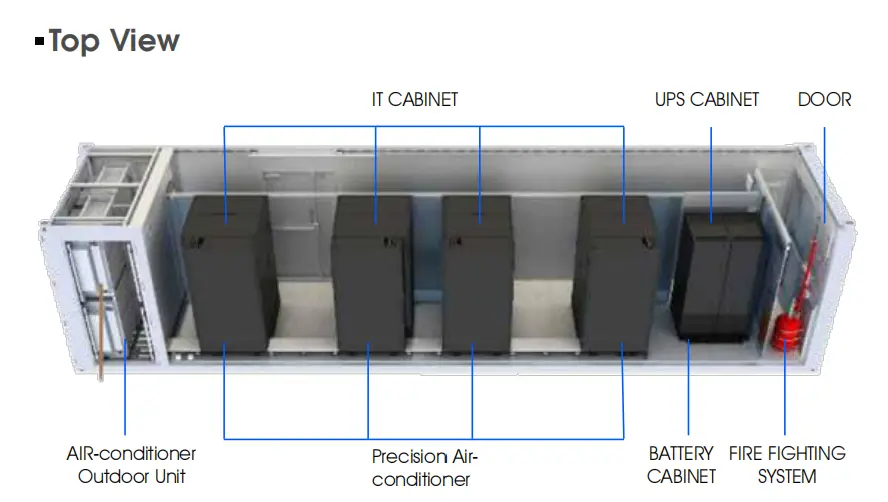
Deployment timelines illustrate the advantage. DTVS's AI-Core configuration — a 40-foot high-cube ISO container supporting 300-600kW total power and up to 100kW per rack — ships with direct-to-chip liquid cooling integrated, achieving PUE as low as 1.08 and deployment in 90 to 120 days. For hyperscale clusters, the AI-Flex configuration interconnects 4 to 20+ modules to deliver 2-20MW total power, scaling to 2,048+ GPUs with PUE below 1.10. The AI-Edge configuration targets edge inference with 20-foot containers delivering 80-200kW total power and deployment in 60 to 90 days.
Industry Deployments in Focus
The pace of adoption is accelerating across geographies and use cases. LG CNS launched its containerized "AI Box" data center in March 2026, with each unit housing up to 576 GPUs and a power capacity of approximately 1.2MW. The company reports deployment in roughly six months, compared to more than two years for a conventional build, and plans to deploy an "AI Box campus" in Busan combining approximately 50 modules across 27,000 square meters.
In the United States, Armada deployed its 40-foot Triton containerized data center to GrandSky at Grand Forks Air Force Base in North Dakota. The Triton model offers five racks of compute within a 40-foot container, enabling customers to process sensor and aircraft data locally and run AI and machine learning applications at the edge. "The AI race isn't even a once-in-a-generation race, it's a once-in-forever race," said Armada co-founder and COO Jon Runyan. "To win, we have to build and deploy AI infrastructure ahead of demand".
The Chinese Market: Prefabrication at Scale
China's AI infrastructure sector has moved aggressively into prefabricated containerized solutions. TaiChu (Hangzhou) Integrated Circuit Co. unveiled a distributed compute solution built around standardized containerized compute units, with factory prefabrication rates exceeding 90% and on-site commissioning within 24 hours. The product matrix includes air-cooled 45-foot containers delivering 80 PFLOPS at FP16, liquid-cooled 20-foot containers with 128-card high-density compute, and 45-foot three-chamber clusters supporting 256 cards with 307 PFLOPS of sparse compute — sufficient for medium-parameter model pre-training.
Alibaba Cloud has similarly embraced full modularization for its AIDC architecture. The company's CUBE 5.0 design raised the modularization rate of power, cooling, security, intelligence, and fire suppression systems from 30% to 90%, compressing AI data center delivery timelines from over six months to 100 days. This "building blocks" approach allows parallel factory production and pre-commissioning of independent modules, followed by on-site assembly via crane lifting and splicing.
Cooling as the Enabling Technology
The shift to containerized AI infrastructure is inseparable from advances in liquid cooling. Graphics-accelerated workloads routinely push rack densities past 40kW, a level that conventional air systems cannot support without breaching energy budgets. Direct-to-chip cold plates, rear-door heat exchangers, and single-phase immersion loops now ship pre-integrated inside factory-built enclosures, enabling modules to host 700W accelerators today and roadmap-ready 1,000W devices tomorrow. Schneider Electric's liquid-aware orchestration dynamically regulates flow rates and fan curves, producing PUE ratios near 1.15 versus 1.4 for legacy air designs. Vertiv pilots in 2025 trimmed facility energy use by 30% by coupling coolant telemetry with machine-learning fault prediction.
The Capex Equation
The capital expenditure profile of containerized solutions is evolving. Factory integration, crating, and specialized power or cooling assemblies add a 20-30% premium per megawatt compared to stick-built halls, according to industry analysis. However, this premium is offset by dramatically compressed timelines that accelerate ROI. For small and medium enterprises, leasing models are emerging that shift capex to opex, though at the cost of operational autonomy.
Domestically, the economics are compelling. A 1-megawatt traditional data center in China costs approximately 18 million RMB to build, while containerized solutions can reduce this to under 8 million RMB, with PUE as low as 1.2 and WUE of zero. The containerized SST DC mobile intelligent compute center, developed by Loongson Technology with Delta and Hanteng Technology, utilizes an 800V DC power supply architecture achieving over 98.5% end-to-end energy conversion efficiency and can be deployed and operational within 24 hours.
The Road Ahead
Containerized AI data centers represent more than a technical choice — they signal a paradigm shift from building infrastructure to manufacturing it. This transition equips compute deployment with software-like agility: scale on demand, iterate rapidly, and control risk.
Challenges remain. Proprietary coolant manifolds, busways, and control software harden switching costs, and a 2025 operator survey found that two-fifths delayed adoption primarily due to vendor lock-in concerns. Supply chain lead times for pumps, heat exchangers, and dielectric fluids require multi-sourcing strategies. But the trajectory is clear. For enterprises planning AI infrastructure, the question is no longer whether to adopt containerized solutions, but how fast they can deploy them. When compute demand grows by the quarter, deployment speed itself becomes the competitive advantage.